
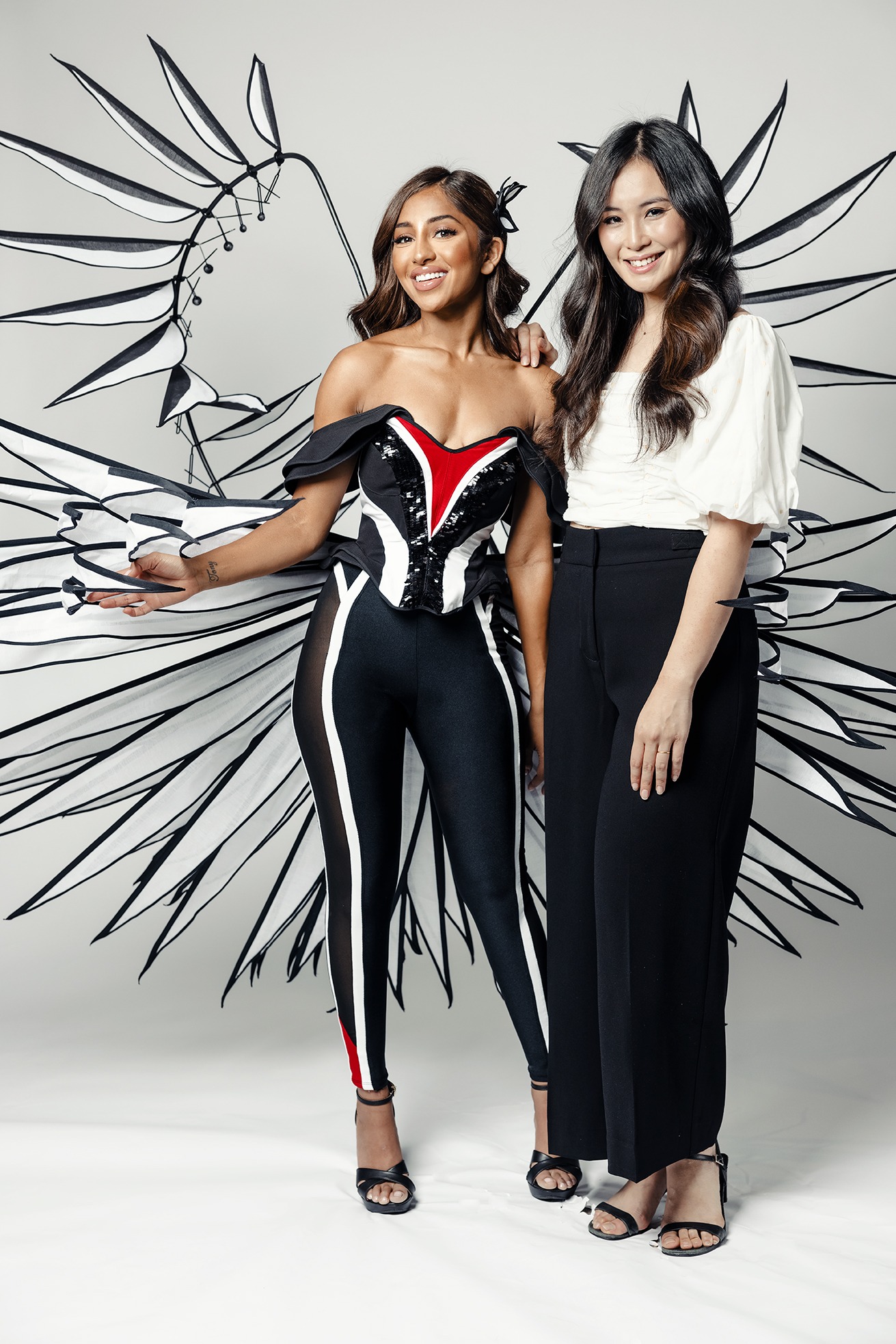
There is something wonderfully incongruous about imagining a national costume for Miss Universe Australia taking shape in a suburban Perth bathtub.
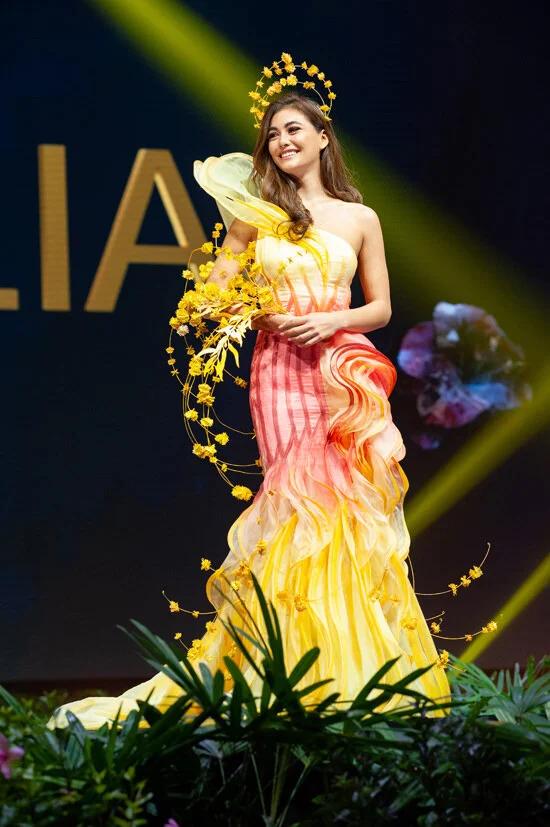
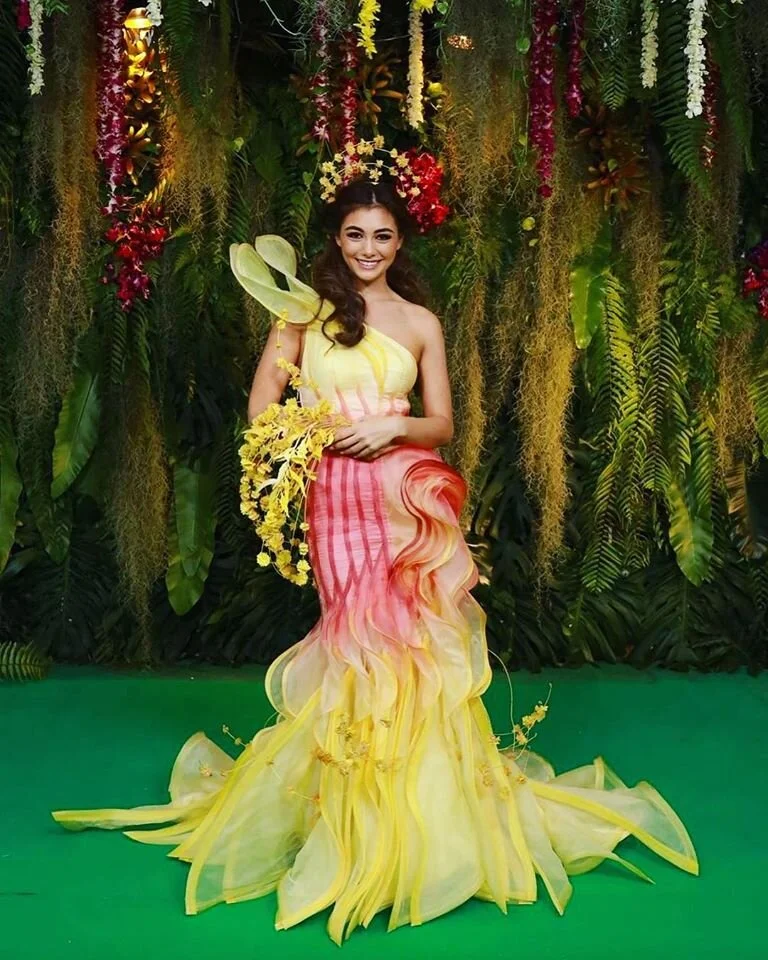
More than 20 metres of silk organza had to be cut, coloured and coaxed into place for Nicola “Nicky” Yeung’s Golden Wattle costume, worn by Francesca Hung at Miss Universe 2018. Some pieces were draped and re-draped on a mannequin; others were wired and reinforced so the garment could hold its sculptural form. The ombré colouring had to work across different fibres, despite the unpredictability of the dye. And much of that colour came from Nicky, with the help of her mother and brothers, hand-dyeing fabric at home.
“It was really a very organic process… And there was a lot of dyeing in my bathtub at home too!”
It is a disarmingly domestic detail behind a costume created to represent an entire country. Yet it also says much about Nicky’s approach to design. Her work can be theatrical, intricate and meticulously engineered, but its beginnings are often tactile and hands-on: fabric, wire, colour, experimentation and many hours spent working out how something should fall, move or take shape.
Long before Miss Universe came calling, however, Nicky was a Perth teenager wondering whether fashion was even the right career path for herself.
01
Finding her way into fashion
Nicky’s interest in fashion design emerged during high school, when she began entering competitions and found herself winning or placing in finals. The encouragement gave her the confidence to consider fashion seriously, although she had reservations.
She loved art and making beautiful things but did not see herself as particularly trend-driven. Fashion also appeared to be, in her own words, an “unsteady” career path and, at times, overly materialistic.
Her mother helped change her mind. She had once wanted to become a fashion designer herself before choosing law, and she encouraged her daughter to pursue the creative path she was drawn towards.
There was also a question that would remain with Nicky: could creative work have a purpose beyond simply making beautiful objects? She wondered whether her skills might one day help people in some way, even if she did not yet know what that would look like.
After high school, Nicky enrolled at Curtin University, completing a degree in fashion and textiles. At the same time, she worked in a fabric store, an experience that gave her the sort of practical education difficult to acquire from books alone: how cloth behaves, how it hangs and how dramatically different materials can respond once cut and placed on a body.
Her career after university was equally varied. She worked as a patternmaker and draftsperson producing medical splints for people with neurological disabilities before returning to study Fashion Technology at Polytechnic West, now South Metropolitan TAFE, to further refine her technical skills.
From there she entered the commercial fashion world as a women’s and girls’ design and production assistant for an Australian surfwear brand. She learnt what happens behind the polished storefront of a clothing label—production schedules, development and the practical realities of turning an idea into something that can actually be manufactured.
She eventually progressed from assistant to junior designer and then designer. But outside her full-time work, Yeung was quietly developing another side of her creative life. She designed and sewed freelance pieces, created small collections and organised editorial shoots. Those photographs went onto her website and Instagram page.
Someone at Miss Universe Australia noticed.
02
The Golden Wattle
The invitation to create a national costume gave Nicky an opportunity to think on a much larger scale.
Her first design, for Miss Universe Australia 2018 Francesca Hung, drew on Australian native flora, most prominently the Golden Wattle.
The national flower offered more than colour and visual drama. The Wattle can endure drought, wind and bushfire, making it an emblem of resilience. For Nicky, it could also speak to unity and to the multicultural character of contemporary Australia.
The costume incorporated references to the Waratah, the floral emblem of New South Wales, where Francesca is from, and the Kangaroo Paw, Western Australia’s floral emblem and a connection to the state where the costume itself was conceived and made.
The result was a riot of organic forms: blossoms cascading across the gown and headpiece, laser-cut florals, fine metal wiring and layers of hand-dyed silk organza. Despite the precision of the finished piece, Nicky remembers its creation as highly instinctive.
There was no perfectly predictable path from sketch to gown. Instead, she worked directly with the material—draping, adjusting and experimenting until individual pieces sat as she wanted them.
Dyeing presented its own difficulties. Achieving consistent ombré effects across natural and polyester fibres was unpredictable. Beneath the apparent softness of the finished gown was also a considerable amount of hidden structure, with layers reinforced and wired into place.
At times, Nicky says, getting those structural elements through the sewing machine felt more like a physical contest than dressmaking. Of all the pieces she has created, the Golden Wattle remains perhaps the closest expression of her own design instincts.
“It is in essence very much a representation of my uninhibited unique design style.”
03
Enter the Black Swan
When Nicky was asked to create another Miss Universe Australia national costume, this time for Maria Thattil in 2020, she did not repeat herself.
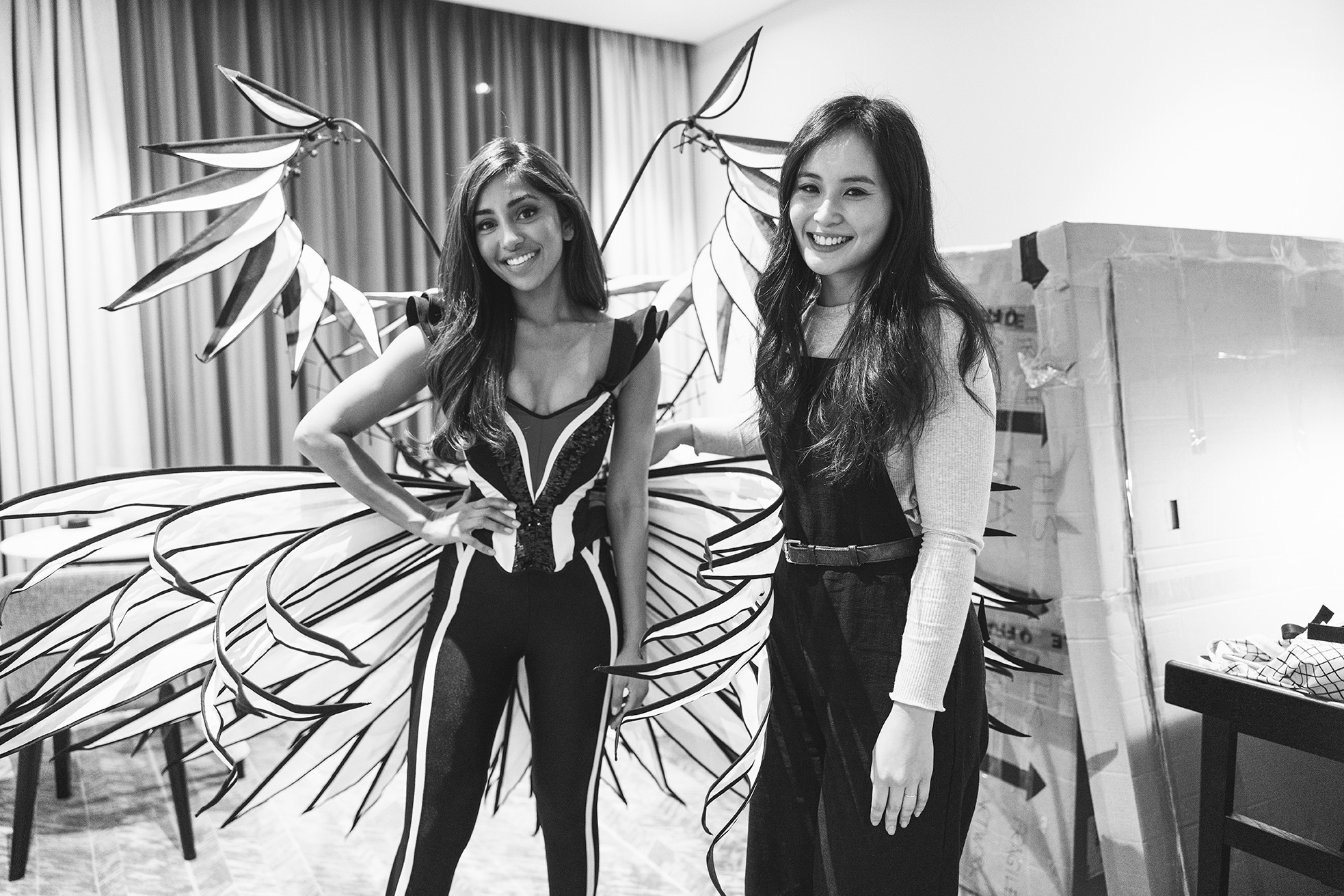
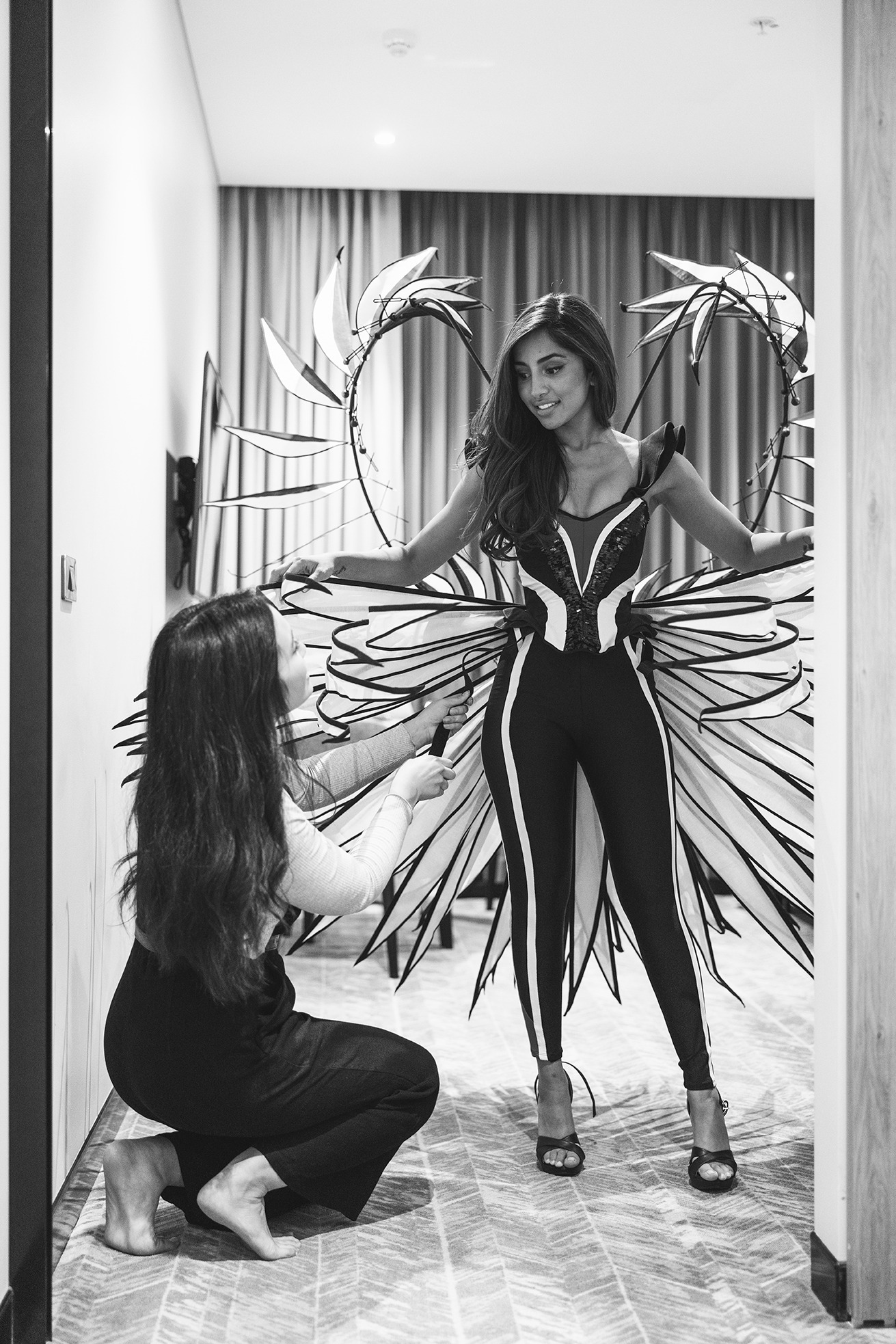
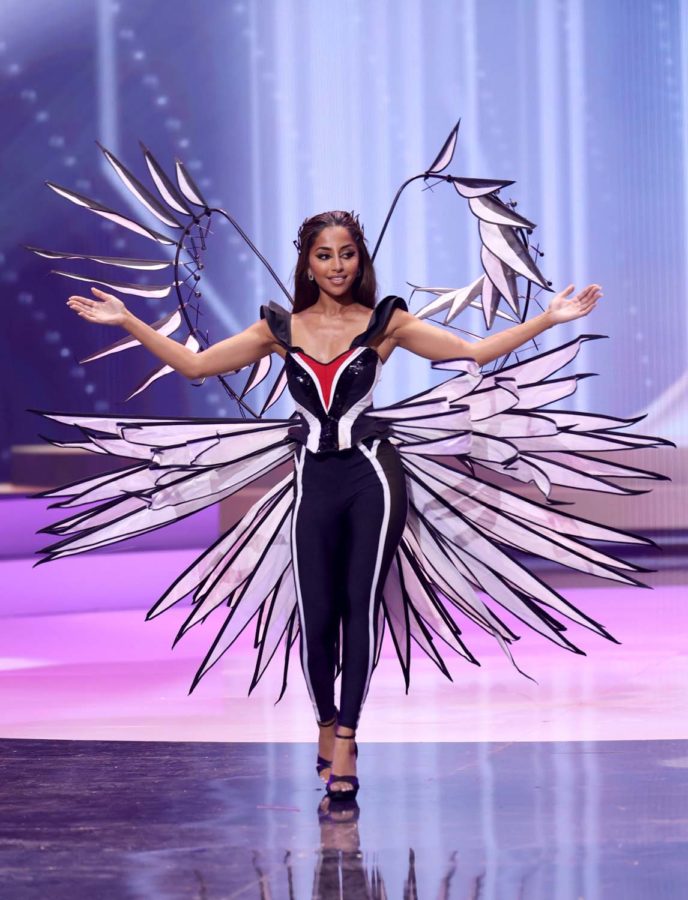
Instead of flowers, she turned to a creature she had seen throughout her life in Western Australia: the black swan. Visually, it was irresistible.
“Black Swans are such stunning creatures. I was drawn to their bold symmetrical features, the stark contrast between the black plumes, the red of the beak, and the shot of white that is seen in full view when the bird is in flight.”
Those characteristics also translated naturally into clothing. A swan’s wings could frame the wearer, creating spectacle without swallowing the person inside the costume.
The fact that the black swan is Western Australia’s faunal emblem added another layer of meaning, although Nicky says that connection was almost fortuitous. Growing up around the birds may simply have lodged their forms somewhere in her visual memory.
There was symbolism too. For centuries in Europe, a black swan represented something believed to be impossible because swans were assumed to be invariably white—until Europeans encountered black swans in Australia.
For Maria, who had spoken about challenging expectations and breaking barriers, Nicky saw an appropriate parallel: the unexpected becoming possible.
But translating a bird into a national costume presented a new problem. Nicky wanted the wings to move. Fashion alone would not be enough.
04
When fashion meets engineering
To make the costume work, Nicky collaborated with an engineer named Stuart, whom she describes as a multidisciplinary artist as well as the technical mind behind the mechanical system.
The pair considered different ways the costume might operate, combining Nicky’s knowledge of garments and construction with engineering and kinetic structures. For Nicky, it was challenging, albeit unfamiliar territory.
Electronics and moving structures had not been part of her earlier fashion work. To complicate matters further, COVID restrictions meant she could measure Maria only once before the finished costume had to be delivered. There would be no series of fittings to gradually refine the shape.
Nicky responded practically, selecting fabrics with stretch to create some tolerance in the fit. And, as with the Golden Wattle costume, the work took place around the demands of her regular job.
“Lots of late nights and early mornings, catching windows of time outside my full time job!”
It was a reminder that even work destined for an international stage can be assembled in far less glamorous circumstances—between ordinary working days, during evenings and in stolen hours before morning.
Unfortunately, when Maria eventually walked out on stage at Miss Universe 2020, a backstage problem meant the wings did not operate as intended. For a designer who had invested so many hours in making them move, it was disappointing. But the larger experience remained.
Her work had made it from Perth to one of the world’s most visible pageant stages.
05
Designing from the west
Perth appears repeatedly in Nicky’s work, sometimes deliberately and sometimes less consciously. She grew up surrounded by suburban nature, and its patterns continue to fascinate her: repetition, geometry, texture, colour and the underlying structure within organic forms.
Look closely enough at nature, she says, and something apparently wild can become almost mathematical.
“The interplay of organic forms and structure has always been so beautiful and fascinating to me—I think it will be a life-long love of mine!”
That interplay can be seen in both Miss Universe costumes. The Golden Wattle appears abundant and free-flowing, yet relies on carefully engineered support beneath its layers. The Black Swan takes something organic—a bird in flight—and turns it into a garment whose movement depends on mechanical design.
At the same time, she is realistic about the limitations of building a fashion career in one of the world’s more isolated major cities. Sydney and Melbourne offer greater access to fashion networks, specialists and manufacturers; Europe and the United States offer more again.
But distance can have another effect. Away from the concentration of trends and industry influences found in bigger fashion centres, a designer may develop a visual language that is more distinctly their own. For Nicky, isolation is therefore not necessarily a creative disadvantage. It may even encourage originality.
06
A multicultural thread
There is another idea quietly running through Nicky’s work: multicultural Australia.
She describes herself as a “third-culture-kid”, so questions of belonging, cultural identity and the meeting of different backgrounds have long sat somewhere in her consciousness.
Both Francesca Hung and Maria Thattil also came to the Miss Universe Australia title with diverse cultural heritages. Nicky says she did not begin either project by deliberately setting out to make multiculturalism its central message. Instead, it surfaced naturally.
Perhaps that is what makes the symbolism effective. It is woven through the designs rather than added as an afterthought: different flowers contributing to a single Australian landscape; a black swan challenging assumptions about what a swan should look like.
National costumes, of course, are never neutral. They are judged not only as clothing but as statements about what a country chooses to show the world. Nicky’s approach to that pressure is characteristically measured.
“You just have to offer your best, try to be kind and respectful, and leave the rest in God’s hands.”
07
From Perth to the archive
The two costumes are now set to have another life beyond the pageant stage.
According to Nicky, both are being donated to the WA Museum collection. They are not currently on display but will be preserved for the possibility of future exhibition.
It seems an appropriate destination. The costumes are pieces of fashion, certainly, but they are also records of a particular Australia: native flora, Western Australian wildlife, multicultural identities and the work of a Perth designer translating familiar things into something theatrical enough to carry onto an international stage.
For Nicky, seeing those creations finally appear before an audience brought the peculiar rush that comes when something imagined privately becomes public. She compares it to an actor stepping onto a stage or a musician releasing a piece of music.
Yet perhaps the most revealing insight into her creative process comes not from the glamour of that final moment, but from what she remembers thinking while she was still in Perth, surrounded by unfinished fabric, technical problems and looming deadlines.
Did she stop to contemplate the significance of making something that would soon represent Australia? Not exactly. Her thoughts were considerably more immediate:
“Panic, panic! I need to get this FINISHED!”
And perhaps that is the real story behind the spectacle. Before the international stage, before the photographs and before a costume becomes part of a museum collection, there is simply a maker—cutting, dyeing, wiring, sewing and trying to bring an idea into existence.